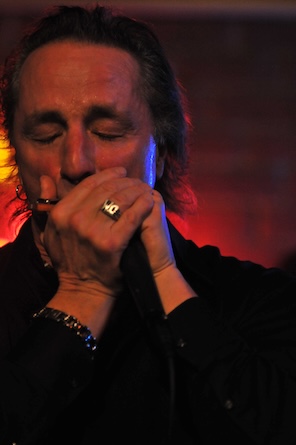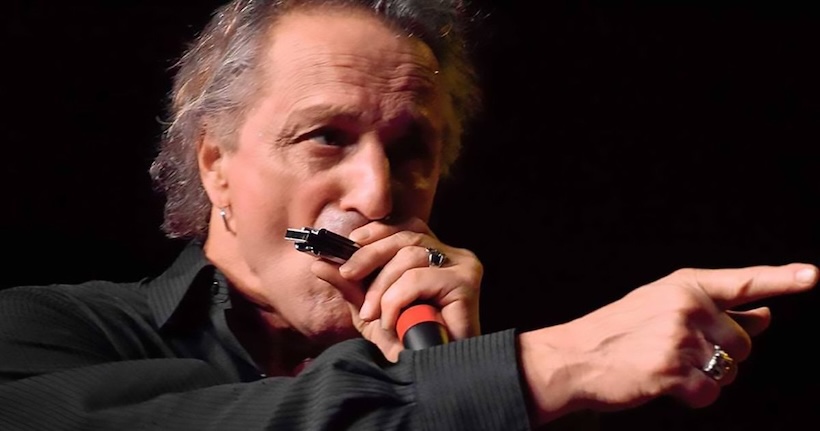
In the early 1970s, Boston’s music scene was in the midst of a rock revolution. One of the young musicians at the forefront of that movement was singer and harmonica player James Montgomery. Along with fellow Boston acts like The J. Geils Band and Aerosmith, The James Montgomery Band helped spearhead a new generation of blues-based rockers.
More than 55 years later, Montgomery is still at it. Now a resident of Newport, R.I., he spoke to PortsmouthNH.com in advance of his band’s upcoming concert at Jimmy’s Jazz & Blues Club in Portsmouth on Thursday, Oct. 1. During a video interview, Montgomery discussed his breakthrough in Boston. He also shared stories about collaborating with other music legends, and mused on the enduring power of the blues.
The following interview has been edited and condensed.
Portsmouth isn’t far from where your band got its start. You formed The James Montgomery Band when you were still a student at Boston University, somewhere around 1970. Is that about right?
Yeah, that’s about right. Unofficially ‘69, officially ’71, so that’s perfect. We played the Portsmouth area quite frequently, and in Durham at the college up there. That was a regular stop for us, so we really loved the area. And Portsmouth is such a hip little town. It’s just so great. It’s great to be there. And Jimmy’s Jazz & Blues Club is a gorgeous room. It looks like Architectural Digest inside, so it’s just a really great place to play.
What was Boston’s music scene like back then, in the early ‘70s?
Well, it was extremely vibrant. You know, I grew up in Detroit. I was in a jug band, but some of the guys used to summer out here in the Vineyard and stuff. … So, I was very familiar with the music scene in Boston. So, you know, I got accepted in different colleges, but I did get accepted at Boston University, and so I was thrilled to come to Boston.
The music scene was already vibrant when I got there. You know, you had to figure out which national artist you wanted to see on any given night. Muddy Waters would be at Paul’s Mall, Cream would be at the Tea Party, Jefferson Airplane would be somewhere else. And then there’d be great folk artists at Club 47, so it was very vibrant.
Back then, when I was starting, me and Aerosmith and J. Geils got started around the same time. J. Geils was a year or two ahead of us, but me and Aerosmith started around the same time. As a matter of fact, they were my opening band on a couple of shows. But there were a lot of places to play. And, as opposed to the Midwest, you know, in those days in the Midwest if you didn’t play cover tunes you didn’t work. But in the Boston music scene back then, if you played cover tunes you’d be farmed out to someplace in Revere or Lynn or something. … If you wanted to work in Boston, you had to play original music.
Between your band and J. Geils and Aerosmith, all coming up more or less at the same time, I mean, did you know at the time that something special was happening?
You know, we really did, to be honest with you. And then in Cambridge there was a whole scene (with) me and Bonnie Raitt, Livingston Taylor, Spider John Koerner, Reeve Little, and John Pousette-Dart. You know, we were all kids, none of us had careers, and we’re all hanging out in Cambridge every night together. One night we’d go to my band’s house, the next night we’d go to Bonnie’s house on Oxford Street. And we all sensed that something great was going on.
… We had a house in East Cambridge and J. Geils had a band house on Kempton Street, over by Huntington. And then Aerosmith had a band house on Commonwealth Avenue. The band Swallow … had a band house on Newton Corner. And it was incestuous, you know? I would go to the J. Geils band house and watch him rehearse, or I’d go hang out at different band houses. And, honestly, we all did have a sense that we were going to be part of a rock and roll community nationwide. We all imagined that we would be making records and touring and all that. And we all did.
So, you were a young college student, but you also had this thrilling music career happening. And you had to make a decision after college whether you were going to get a more traditional job, or go tour with the Allman Brothers! Was that a difficult decision for you, or were you all in right away?
Yeah, it wasn’t really that difficult a decision. I took my education very seriously. I encourage young people to do the same thing. … At Boston University, they kind of indicated that if I went to spend a year at the school of education I’d probably be in good shape to become a college professor. But, you know, my band in college was really good, and we were doing really good, big numbers. We got a call from the Allman Brothers and their label and he gave us an offer that we couldn’t refuse.
My father always said in those days, “Twenty thousand dollars on your education and now you’re going to make a living playing a child’s toy!” That was my father’s favorite saying. I’ve always appreciated that quote.
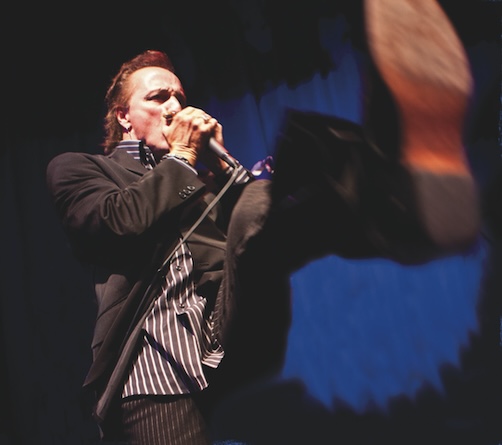
You’ve collaborated and performed with so many iconic artists over the years. Are there any collaborations that stand out in your mind as being really special to you?
Yeah, you know, when I was a kid, like I say, I started a jug band. I didn’t play the washtub in the band, I wasn’t as good as the washtub player. But I would practice with the washtub and the harmonica rack in my basement, listening to Jimmy Reed records, probably playing the wrong key on harmonica, now that I think about it. But, you know, I would dream about B.B. King and Muddy Waters and Buddy Guy, Junior Wells, Paul Butterfield, The Rolling Stones, The Beatles, and eventually I got a chance to play with everyone that I used to dream about. I didn’t play with The Beatles, but I hung out with George (Harrison) for a day or two. Didn’t play with the Stones, but hung out with Mick (Jagger).
But the people that I was thrilled to play with, you know, obviously Muddy Waters, only one night. Meeting and playing with Les Paul was a thrill. I ended up playing with him quite a bit. I made a record with Catfish Hodge, with Bonnie Raitt and Dr. John on it. That was a great collaboration. And, you know, being able to jam with Bobby Rush, B.B. King, John Lee Hooker, James Cotton, Buddy Guy, Junior Wells. I mean, I played with all of those guys, and some of them became lifelong personal friends. And so those collaborations were great. And also, I always loved sitting in with the Allman Brothers or Gregg Allman & Friends. It’s always great sitting in with Aerosmith, with Steven (Tyler). Steven and I used to play harmonica together. So, you know, there’s a long list of them, and I’ve been blessed to be able to be with a lot of these people.
Years ago I had a chance to interview Johnny Winter, who I know you played with a lot. … It seems like you guys had a lot of shared influences, that you were almost like kindred spirits, musically. What was it like playing in his band for five or six years?
… Johnny Winter, to me, of all the people I’ve met, was the most unique person in this business. He kind of lived in his world, which was a world that was so steeped in blues and R&B. He was the embodiment of a blues musician, everything about him. There wasn’t one thing he did that didn’t, like, exemplify the life of a blues musician. He was a hundred percent. And one of my job responsibilities was to stay up all night with him, because he was never up in the daytime. … We would listen to the blues station and this game kind of evolved where, after the first couple of notes, you’d have to hurry up and guess who the musician was and what the song was. And I was pretty good at it, but Johnny won about ninety-eight percent of the time. (Laughs.)
And talk about a blues musician. I brought in a George Jones record for him one time to listen to on the bus and played some ballads. And of course every George Jones ballad is the most heartbreaking thing ever. … After about the third George Jones song, Johnny goes, “Take this off! This is too depressing!” So, George Jones was too depressing for a blues man.
So many genres and subgenres of music have come and gone over the course of your career, but blues and blues-rock haven’t gone anywhere. What do you think it is about the blues in particular that still seems to resonate with audiences, no matter what era we’re in?
Every blues musician, almost, ninety percent of them anyway, could tell me the moment that they realized that that’s what they wanted to do. You know, I don’t know, it might happen in rock and roll, but I think in rock and roll it’s more like you want to be in a band, you want to play guitar, you want to wear Beatle boots, you want to get girls. I don’t know. But every blues musician has this moment. You know, it’s a niche market, but still with a considerable amount of people that are blues fanatics, and I think they’re able to recognize that moment in themselves and in the artists who play that are able to communicate that moment.
My second record was produced by Tom Dowd, who of course did Aretha (Franklin) and Ray Charles and the Allman Brothers and everybody, so he’s a knowledgeable guy. And he told me, he said, “You know, James, blues is going to be cyclical. You know, it’s going to go in cycles. But there’s always going to be another rise in it, another new group of people to come to it and support it. And it’ll be here forever.” And so far Tom Dowd has been correct.
So, you’ve got this show coming up in Portsmouth. After 50-plus years, do you still get the same thrill out of performing for a live audience as you always have?
Absolutely. It’s still as exhilarating as it ever has been. Sharing that energy with your bandmates and the audience is just such an incredibly wonderful thing.
What can folks expect in Portsmouth? Anything you want to share about the upcoming show?
Well, yeah, we are gonna switch to a double-drum configuration, like the Allman Brothers and the Grateful Dead. And we’re bringing in a saxophone player from The Beach Boys. And then my band, of course, is one of the best bands in the country. And we’ve got some brand new songs we’re going to be playing, and then also we’re bringing up some of the old stuff, like “Train” and “Schoolin’ Them Dice.” So, we’re doing something for everybody. The band has a gas playing with each other. We’re going to have a great time, the music is going to be at a very high, energetic level. We’re gonna kick ass, and it’s gonna be fun.
The James Montgomery Band performs at Jimmy’s Jazz & Blues Club in Portsmouth on Thursday, Oct. 1, at 7:30 p.m. Learn more here.