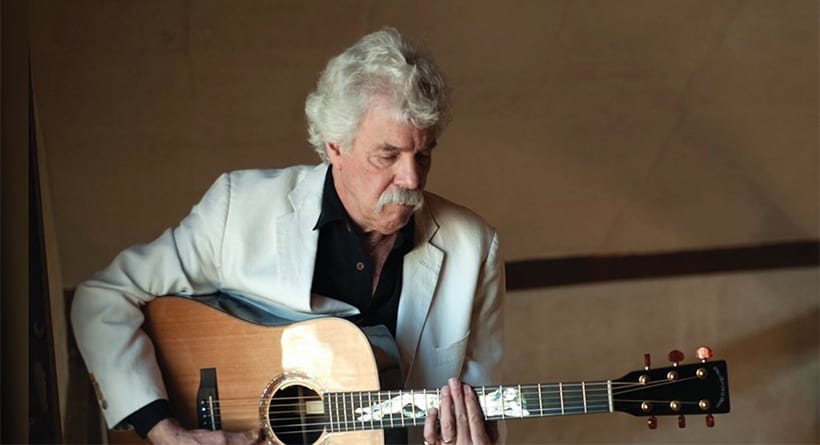
Few musicians can boast a more impressive resume than Tom Rush. A leading figure in the folk movement of the 1960s, as well as its revival in the ’80s and ’90s, Rush helped launch the careers of Joni Mitchell, James Taylor, Jackson Browne, Nanci Griffith, and Shawn Colvin, among others. His work has been covered by everyone from Waylon Jennings to U2. Rolling Stone has credited Rush with ushering in the singer-songwriter era. (“They never proved anything. I was never indicted,” he jokes.)
But Rush doesn’t dwell much on his legacy, or on his place in American music history.
“I’m much more focused on today than yesterday,” he said. “Today, and what’s going to happen tomorrow.”
He’s also focused on what’s going to happen about a week from now, when he takes the stage at the Prescott Park Arts Festival on Saturday, Sept. 5. The show has been a long time coming; Rush was scheduled to perform at the festival last summer, but the concert was cancelled due to weather.
The upcoming date also represents a homecoming, of sorts: Rush was born in Portsmouth and grew up in New Hampshire.
“I didn’t spend much time in Portsmouth because I was an adopted kid, so I was whisked away almost immediately,” he said. “But I’m now living right across the river from Portsmouth. I’m in Kittery, so I’m a neighbor.”
Opening the show at Prescott Park — and accompanying Rush on stage — is Brendan Cleary. Rush first saw Cleary perform at a bar in Boston and has been touting his music ever since. (He noted that Cleary will return to Portsmouth for two shows at The Music Hall Lounge on Sept. 10-11.) Throughout his own career, Rush has made a point of bringing exposure to younger musicians.
“There’s so many really, really talented youngsters out there that have no way to advance their careers,” Rush said. “The record companies don’t want anybody except superstars. And if they do hire you, they want you to sign away your life and name your children after them and everything. And meanwhile, everything’s online, and 20,000 plays on Spotify won’t even buy you a cup of coffee.”
But Rush has been advocating for other artists since long before Spotify was in the equation. His classic 1968 album “The Circle Game” featured three songs written by Joni Mitchell, as well as covers of James Taylor and Jackson Browne. All three singer-songwriters were virtually unknown at the time.
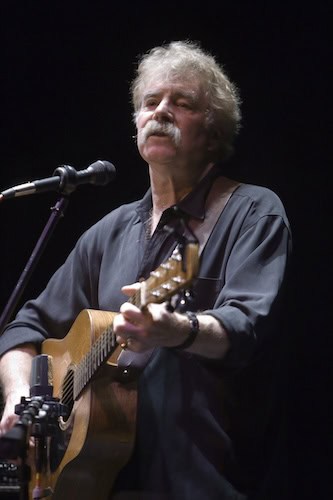
photo by Michael Wiseman
Taylor gushes about Rush’s influence in the 2013 documentary, “No Regrets.” And Mitchell has said that Rush was one of the few people who recognized her strength as a songwriter early on.
“I was the first to cover her songs,” Rush said. “She was in a folk duo with her husband, Chuck Mitchell. And she said, in a book about it, she said, ‘Chuck didn’t like my writing … but Tom Rush did.’ Apparently, Dave Van Ronk told her she should become a fashion model. And Pat Sky told her her songs sucked. But, you know, I took her on the road with me so she could play for people. And I think it helped.”
He’s got a keen ear for talent. But it’s hard for him to articulate just what draws him to a particular tune.
“I call it the goosebump principle,” he said. “It’s just, a song gets to me.”
Many artists have recognized the brilliance of Rush’s songs, as well. “No Regrets,” the closing track on “The Circle Game,” has been covered by numerous artists across a spectrum of genres. The Walker Brothers had a major hit with the song. (“Put my first two kids through college, so it’s my favorite version,” Rush joked.) That version, in turn, spurred countless other covers.
“There was a heavy metal version. It was so ponderous, the guy could only get two verses into an eight-minute cut. And there was a hip-hop version that I did not recognize when somebody played it for me,” Rush said. “And then there’s this obscure band from Ireland called U2, I think. … I remember seeing an interview with Bono. The interviewer said, ‘So, you covered “No Regrets.”’ And Bono’s response was, ‘Yeah, that’s Scott Walker (of The Walker Brothers). He’s a genius.’ I said, ‘Excuse me, over here!’ I did get to meet Bono before a show in Phoenix a couple of years later, and he apologized. And I forgave him.”
Stories like that have also become part of Rush’s live repertoire. He’s a great storyteller, with a natural sense of comedic timing. He said he started telling stories onstage to keep the audience engaged while he changed the tunings on his guitar. Pretty soon, he found that the stories were as popular as the songs.
“And so I still tell some of my favorite stories. But there’s others that just pop up, out of the blue,” he said.
Over a career that’s spanned close to seven decades, Rush has accrued quite a collection of stories. After growing up in New Hampshire (his father taught at St. Paul’s School in Concord), he attended the Groton School in Massachusetts. Then he went to Harvard, where he discovered a rich and diverse music scene in Cambridge.
“The town was just so full of music, all these kids playing Delta blues and Chicago blues and Irish-Scottish ballads, and on and on and on. And I got really swept up into it.” he said.
Rush became a regular performer at the Club 47, a coffeehouse and folk music hub located just a block from his dorm. “It was just irresistible. I almost flunked out because of the Club 47.”
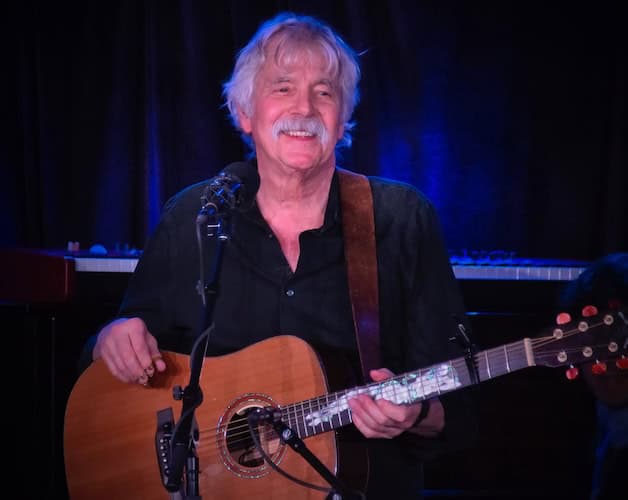
photo by Lawrence White
He eventually signed with Elektra Records, and later with Columbia. He moved to New York and began touring extensively. He kept up a furious pace of rehearsing, performing, and recording. Over a five-year stretch, he says, he only took 10 days off. Finally, he decided he needed a break.
“All my friends in the business were moving to California, moving to the LA area or the San Francisco area, because that’s where the action was,” he said. “And I was so burned out, I wanted to be where the action wasn’t.”
Rush decided to quit showbiz and, like any good New Englander, took a stab at farming. He bought a property in New Hampshire and got a tractor and went to work. But he found that he wasn’t quite cut out for it.
“I came away with an enduring respect for how hard it is to be a farmer,” he said. “This does not come easy at all.”
Gradually, he got back into performing. He also started his own booking agency, called Maple Hill Productions. But, rather than supplementing his income, he found that he had to ramp up his own performance schedule to finance the agency. So he gave up Maple Hill and went back to performing full-time.
Now 85, Rush hasn’t slowed down much. He still performs all over the country, and he hosts a Patreon series called Rockport Sundays, in which he chats and performs with other musicians (the most recent installment features Mark Erelli). He said playing in front of a camera instead of a live audience took some getting used to.
“I had to adjust to the idea that when you tell a joke to a TV camera, it doesn’t laugh,” he said.
Rush is also brainstorming a PBS TV series called “Club 47,” in which he envisions booking folk legends like Emmylou Harris and Joan Baez. (“Maybe Garth Brooks — he claims I’m an early influence.”) The established musicians would then introduce younger, lesser-known artists to help boost their careers.
Young or old, Rush believes good music transcends generational barriers.
“I think the really great songs aren’t time restricted. I mean, they speak to you. They speak to the way you live your life, the way you feel about things. And I don’t think that really changes over the generations.”
The key, he said, is establishing a connection with listeners.
“That’s the magic word,” he said. “The audience doesn’t want perfection, they want connection. … And I’m so far from perfection that this is good news for me.”
Tom Rush will perform with Brendan Cleary at the Prescott Park Arts Festival in Portsmouth on Saturday, Sept. 5 at 7 p.m. There is a $20 suggested donation; table and blanket reservations are available. To make an advance cashless donation, or to reserve a spot, click here.